
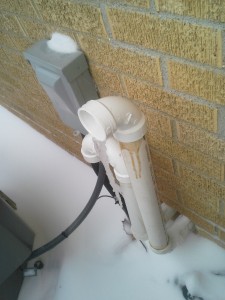
WINTER ADVISORY – Check Exhaust Pipes are Free From Drifting Snow
January 5, 2014
Due to the winter storm hitting central Illinois this weekend, it is important to take some safety precautions to make sure any exhaust vents from furnaces, boilers, or water heaters coming out the side of the building are not blocked by snow drifts. These exhaust pipes are common in today’s modern “high efficiency” gas appliances. Older appliances that are less efficient will exhaust up a metal or brick chimney through the roof.
If the appliance has the proper safety features such as a pressure switch, a blocked exhaust vent can cause a furnace to automatically shut down. This is good feature to ensure the safety of the occupants of the home or building but can leave the home without heat at a time of year it is most needed until a repair is made. In the case of a unit that does not have the safety features (or they are not working correctly), there is a likelihood the exhaust gases will back up into the home. Such gases include carbon monoxide and nitrogen oxides that can cause sickness and even fatalities in high concentrations.
Look around the perimeter of the home for white PVC pipes coming out of the building above ground level. You may see just a single pipe, or you may see a pair of pipes next to each other. In a 2-pipe setup, one pipe will exhaust combustion gases from the furnace outside the home and the 2nd pipe is the combustion air intake pipe that brings air into the combustion chamber of the appliance. Some times, the combustion air pipe is not connected to the outside meaning the appliance will pull indoor air in order to burn the fuel. If you only see the exhaust pipe, that’s not technically a problem as long as combustion air requirements have been satisfied from the indoors. However, that’s a discussion for a later article.
Carbon Monoxide Alarms Save Lives
As an added layer of protection, the presence of a carbon monoxide alarm is also both necessary as a safety precaution and required by law in Illinois homes. Units that are readily available in stores will help save your life by alarming at levels of 70 ppm of CO or higher. However, they will not alarm at lower levels that can result in headaches, nausea, or flu-like symptoms. So, you can have a carbon monoxide problem in the home and no know about it. In addition to the regular store-bought CO detectors, we recommend a low-level detector that will alert you to a problem before it because an emergency situation. For examples, check out the CO-Experts or Defender LL6070 for consideration.