
Are heat pump clothes dryers ready for wide adoption across the United States? When it finally came time to replace our old clothes washer and dryer in December 2019, I wanted to test out a heat pump dryer technology that is relatively new to the United States. I’ve been interested in them for several years but had been waiting for the right time to make the leap. I went to the local appliance store and asked the salesman about heat pump clothes dryers. They didn’t stock any regularly in the store but were able to order one which took about 3 weeks to arrive here in central Illinois.
While I didn’t plan it this way, Ask This Old House has a nice overview video of the same model of dryer that I’m reviewing.


What is a heat pump clothes dryer?
First let’s talk about how a traditional clothes dryer works. Whether fueled by gas or electricity, it heats air hot enough to evaporate the moisture in the clothes. A fan inside the dryer pulls air from the laundry room, through the dryer, and vents the moist air to the outside. In a sense, it works like a bath exhaust fan or kitchen exhaust fan to remove moisture to the outdoors. In doing so, it is also removing the home’s conditioned air you are paying to heat in the winter and cool in the summer. As this air escapes to the outside, replacement air infiltrates through gaps and cracks around the building. So, there a few energy penalties to consider – the electricity or gas used to power the dryer while it operates, and the conditioning of the infiltrating air coming from the outdoors. A heat pump clothes dryer is an improvement in both categories.
Instead of generating heat and exhausting it outside, the heat pump will move heat in a cycle that is completely self contained within the dryer. There are 2 sets of coils containing refrigerant. One set of coils inside the machine (under the dryer cylinder where the clothes are located) gets cold enough that moisture condenses out of the air so that the water can be collected and drained away. The refrigerant inside the coils is compressed by the compressor which turns the second set of coils very hot. Air moves through the hot coils before going back into the dryer’s cylinder. And the cycle repeats. This is essentially the process used by refrigerators, freezers, dehumidifiers, central air conditioners, air source heat pumps, and ground source heat pumps.
The Samsung DV22N6800HW dryer that I purchased offers two methods of removing the moisture. There is a drain hose that can be attached to the back of the dryer and run to a floor drain or even into the clothes washer drain pipe. If you don’t have a drain nearby, you have the option to collect the water in a tray at the top of the dryer. The tray easily pulls out like a drawer and needs emptied with each load. Currently, I’m collecting the water using the tray method. There isn’t enough space in my clothes washer drain pipe because I have too many other appliances piping into it at the same time. I will eventually use the drain hose method so that I don’t have to take that extra step of emptying the tray into a sink with each load. However, I really don’t have any complaints about emptying the tray because I have a wash tub nearby and it’s easy to do.The level of water in the tray can be viewed without pulling the drawer out.Here is a view of the water tray sitting on top of the dryer.


Where’s the exhaust pipe? It’s ventless!
The heat pump dryer removes the water from the clothes and sends it to a drain. So, it is no longer necessary to blow the moist air to the outdoors! This is a great energy-savings benefit as you don’t lose all of the conditioned air of the home that is lost to the outdoors. The other major advantage for this style of dryer is that it can solve logistical challenges in finding a suitable termination for the exhaust. You don’t want to locate an exhaust near a patio where people would spend time, nor do you want to vent it into a crawlspace or an attic unless you are asking for future moisture and durability issues! You also don’t want the termination to be near a fresh air intake for a ventilation system, a high efficiency gas furnace, or a high efficiency gas water heater. Without the need for a termination, you have a lot more flexibility in where it gets located.
Plus the HUGE benefit here is that I no longer have to worry about cleaning out the exhaust pipe and dryer termination every 6 months! This is necessary to minimize the drying time of the dryer and to prevent dryer fires.
Monthly maintenance
Because it is very important to keep the heat pump equipment free of debris, there is a secondary area that needs cleaned of dust and debris at the bottom of the dryer. When you open a panel door, you will see metal fins that are a secondary layer of protection for the equipment. Samsung supplies a brush that can be used to dislodge the debris so that a vacuum hose to suck them out. The owner’s manual suggests cleaning the fins every 30 days. It took me roughly 5 minutes to clean it out which was longer than I expected. The lint and dust was packed into the fins, and it took some time to loosen then up enough so that the vacuum could do it’s job. You also need to be careful not the bend the metal fins as they are thin and somewhat pliable. The main criticism I have of this dryer is the effort it took to perform this maintenance. I would prefer to see a secondary filter that can be removed, rinsed, dried, and put back in place such as the ones you find on most new dehumidifiers.
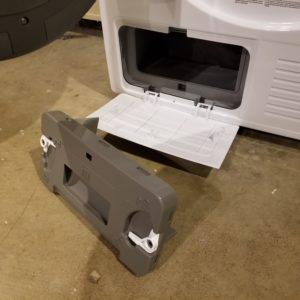
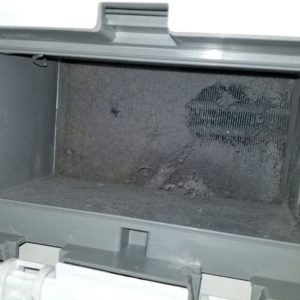
Open the bottom panel door, pull out the gray cover, and clean out debris that is collecting in the fins. Use a brush and a vacuum.This is what the fins look like while I was cleaning the area for the first time.
Does the heat pump clothes dryer operate any differently than a traditional dryer?
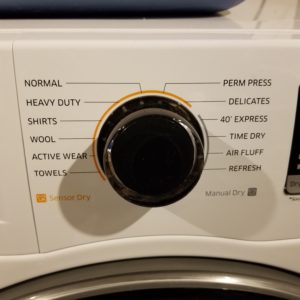
Here are the drying settings you have to choose from.
Not really. You empty the contents of the washer into the dryer. Make sure the lint screens are cleaned out and the water tray (if using that method) is empty. Power it up, choose your setting, and press start. It’s pretty simple. I’ve read some reviews that claimed heat pump clothes dryers are noisier than their counterparts. I do not agree. In my opinion, it isn’t any louder or quieter than a standard dryer. The only noticeable difference is that it does appear the drying time is a bit longer. I wish I had tracked the dryer time from the old dryer before I replaced it, so I don’t have any concrete data to compare to here. However, I estimate it takes anywhere from 15% to 40% longer to dry a load. This will also depend on the volume of clothes in the dryer and how well the washer removed water during the spin cycle. Since I have been emptying the water tray, I have a pretty good idea s to how much water I’m emptying per load. I’ve found the loads with the most water are delicates because the washer (by design) doesn’t have an intensive spin cycle with that setting. So, there is more water to remove by the dryer.
Why I’m returning the dryer to the store
Unfortunately, I have to exchange this heat pump dryer for another model of heat pump dryer. When the delivery crew arrived and opened up the back of the truck, I immediately knew something was wrong. The new dryer was considerably smaller than the new washer. It turns out I had purchased a 4.0 cubic foot dryer with a 4.5 cubic foot clothes washer. I quickly learned that the capacity of the dryer should be roughly 2 times larger than the capacity of the clothes washer to ensure there is plenty of air space to move through the clothes. This dryer would work well for an apartment or for a home with just 1 or 2 people. If you have a larger family like mine, this won’t do you justice. While I wait for the replacement dryer to arrive, I’ve had to purposely wash smaller loads, so it takes longer for me to get through the week’s laundry. I would also add that there is no way a comforter would fit into the 4.0 cubic foot dryer, so I’m looking forward to the larger one.
Before operating it for the first time, I returned to the store to speak with the sales manager. They graciously offered to exchange the dryer for a larger one and are allowing me to use the current one while we wait for the new one to arrive. I had to pay the difference of course. So, my $1079 regular price Samsung dryer turned into a $1609 Whirlpool unit. In my zealousness and excitement when making the initial purchase, I think the original salesman assumed I knew what I was talking about when it came to sizing. While he was researching what was available to order, I was distracting him with my chatter about how they worked.
So, now you will understand while I have “Part 1” in the title of this post. Stay tuned for a follow up review after I have a chance to use the Whirlpool model for a few weeks.
Beyond choosing the appropriate size appliance, here are the key considerations for heat pump clothes dryers:
Pros:
Cons:
