
If so, you are not alone. These are common issues that homeowners have when it comes to efficient water heating in the home. This article addresses these questions and presents some common sense solutions.
Let’s start at the water heater first. There are two basic types—storage tank and tankless water heaters. Most homes today have a storage tank water heater that commonly holds 30, 40, or 50 gallons of hot water. By design, the storage tank must keep water in the tank at a set temperature so it is ready to go at a moment’s notice. As hot water is used throughout the house or heat is lost through the jacket of the water heater, it must kick on to maintain its set temperature.
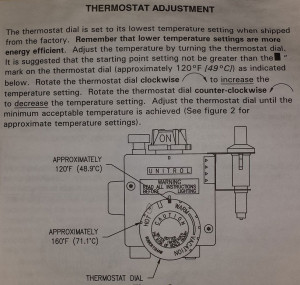
Most water heaters do not show temperature settings on the dial, but the owner’s manual should have a chart showing the temperature for each marking on the dial. (Click to enlarge.)
What temperature should the water heater be set at? Most experts in the field of home performance recommend 120 or 130 degrees Fahrenheit. This provides the best results for performance, safety, and energy efficiency. Most water heaters have temperature settings that can get as high as 160 degrees. At 160 degrees, it only takes 1/2 of a second to scald the skin. This becomes of particular concern when there are children old enough to operate faucets in the home.
Here is a safety chart for how long it takes to scald skin:
Once you turn on a faucet or shower to draw hot water, the distribution system kicks in. This includes a series of water lines that are often made of copper, galvanized metal, or plastic. These lines must travel the distance from the water heater to the end use, and this distance can sometimes be an issue. When the water heater is centrally located in the home or basement, then the lines are usually short enough to do the job. However, in some cases there is a long distance for water to travel. In certain cases, homeowners have elected to install a small point-of-use water heater to guarantee performance.
When the tap is shut off in any design, hot water remaining in the pipe is going to gradually cool down. When the tap is turned back on, that lukewarm or cold water must be purged until hot water from the tank arrives. This is essentially wasted water, so designing the layout of the home properly in the first place is essential for water conservation and for the patience of the person using the water fixture.
To slow the loss of hot water through the pipes, this home used foam wrap with a pre-fitted 90 degree corner to provide continuous coverage.
Once the lines are installed, it is good practice to install pipe insulation around any hot water line to help them maintain their set temperature for longer periods of time. As a rule of thumb, any hot water line that is accessible (not hidden behind a wall) is a great candidate for installing pipe insulation. The only time it may become necessary to do this after the fact is when disaster strikes from the bursting of pipes with frozen water.
Installing pipe insulation is essential for any water line (hot or cold) that travels through unconditioned areas of the home such as through an attic, a garage, or a crawlspace. These water lines are exposed to more temperature extremes than ones who are in the heated and cooled areas of the house with indoor temperatures averaging 70 to 75 degrees. Protecting lines in unconditioned areas will help maintain performance as wall as prevent bursting pipes when water freezes.
While water heater tanks have insulation built into their jackets, at times it may be pertinent to add a water heater tank wrap for extra protection. Good examples would be where the water heater is located in a garage, an attic, a crawlspace or in a very cold cellar. There are also critical installation points to consider when wrapping a tank. For a gas unit, never place insulation on the top of the tank as there is a possibility of melting the wrap, starting a fire, or releasing dangerous fumes like carbon monoxide into the home.
For gas or electric units, there are items that should not be covered such as:
However, most modern storage tank water heaters have plenty of insulation, so adding a tank wrap may NOT help saving on efficiencies.

There may also be so much demand for hot water that the tank cannot keep up. For instance, an old showerhead that delivers 5 gallons per minute of water for a 10 minute shower is going to use 50 gallons of water. Today’s newer showerheads are a standard 2.5 gpm while WaterSense labeled showerheads must deliver less than 2.0 gpm without sacrificing performance. You can apply this same reasoning to faucets in kitchens and bathrooms which should have aerators installed that reduces the flow rate imperceptibly.
Another option might be that the tank’s First Hour Rating (FHR) does not match the needs of the house. This rating determines how much hot water will be available on the busiest hour of the day. For example, an Energy Star rated water heater must have a FHR of 67 gallons or higher. To determine what your “demand” is for hot water in the home, simply determine the household’s busiest hour of the day and calculate how much hot water the fixtures might draw. If the gallons are more than the tank’s FHR, then this might be your problem. Here are some examples:
For homes with a combination of a bathtub and a shower, there may be another problem. After turning on water from the tub’s faucet, the diverter is flipped which directs all of the water to the showerhead. There should be no water coming out of the faucet when the showerhead is in use. If so, this is a waste of water and the energy used to make the water hot. If you find this at home, and call a plumber to report a leaky shower diverter.
By now it should be apparent that energy conservation and water conservation are inextricably related. As you use less hot water, then you use less energy required to heat the water in the first place.

Did you know our Comprehensive Energy Audit includes recommendations for water heating and water conservation? We also test your water heater (among other appliances) for gas leaks. Gas leaks are a dangerous and surprisingly common problem found in the homes we audit.
Call us today at (309) 253-2242 to learn more.
