Building codes have been updated over the past several years to include important energy efficiency improvements. The state of Illinois adopted the IECC energy code for new construction and additions which requires such measures as higher levels of insulation, better windows, and improved efficiency of furnaces.
All of these steps will provide a more comfortable home with lower utility bills throughout the life of the building. It would make sense that older homes would benefit from a strategic plan from an energy audit as there is ample room for improvement to upgrade homes to today’s standards. So, why would a newer home built within the past several years have need of an energy audit?
In recent months, I have been called out to assist homeowners and contractors to solve problems with a number of homes with ages such as 12 years old, 2 years old, and even brand new. It wasn’t high utility bills that caused them to pick up the phone, it was complaints that areas of the home were not heating or cooling properly.
In a few cases, I was called out to solve why condensation was appearing on ceilings or mold behind baseboards and in walls. In all cases, the homes were well built with thoughtful design features that would be attractive to any new home buyer.
However, the devil is in the details. When you look at the house as a system, these homes were displaying symptoms that pointed to the fact that the home’s performance the problem. The pieces of the home were not working together properly which cause them to be less efficient, less comfortable, and have degraded indoor air quality.
Problems an Energy Audit Can Find in a New Home
Here are some of the things that can go wrong with the performance of a home in new construction.
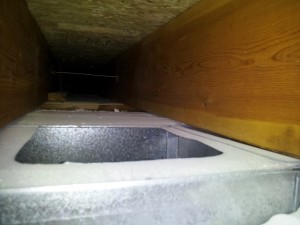
Is the problem with the furnace? – When there area uneven temperatures in the home, there is likely one of 2 causes leading to comfort complaints. It could be the heating/cooling system, or it may be a problem with insulation. Your furnace and air conditioner may be able to heat and cool all day long, but that won’t be effective if the air flow isn’t right. Improper duct design or duct leakage will prevent certain areas from getting good air circulation. Diagnosing problems like these involve measuring air flows and testing for leakage in the ducts.
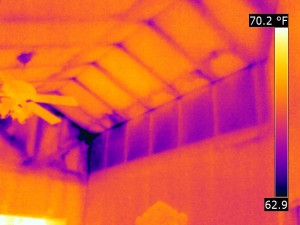
Is the problem in the insulation? – A lot of things can go wrong with insulation in a home. If thereIn this example, you can see how the insulation over the slope is helping the ceiling but no along the cold vertical wall underneath.is air leakage moving through the insulation or the insulation isn’t in contact with the other side of the drywall, the thermal performance will greatly decline. If insulation is missed in building cavities such as walls or bathroom or kitchen soffits, that clearly will cause comfort problems in the associated rooms. Once the dry wall and ceilings are in place, identifying these problems without the help of a thermal imaging camera can be almost impossible.
Where did that condensation or mold come from? – One of the primary performance features of any home or building is its ability to shed water to protect the durability of the home and prevent the growth of mold that can negatively impact health of the occupants. This topic is complex and could be an article in itself. Simply put, the building components need to shed rain water, be tightly constructed to prevent air leakage (and moisture that comes with it), and account for the vapor pressure to allow drying to the inside and outside depending on the season. We also need to provide proper ventilation in homes. Tightly constructed homes do a great job being energy efficient but also do a great job of holding moisture created inside the home. We need ventilation controls for showers, cooking, and overall good indoor air quality. Testing for tight homes is easy enough to do with the blower door test, and the solutions are fairly straightforward with a variety of prices.
At the end of the day, the building codes are certainly helping to improve the home’s efficiency and comfort. With those two elements in place, the home becomes a comfortable refuge that we all want in a home. However, mistakes can happen with the installation of components like duct work or insulation, and finding the cause may not always be apparent without the right tools for diagnosing. If you are having problems like these in your home, give us a call. We just might have the right solution to get your home FEELING like a home.